All-American
The most common dog in America has no breed at all.
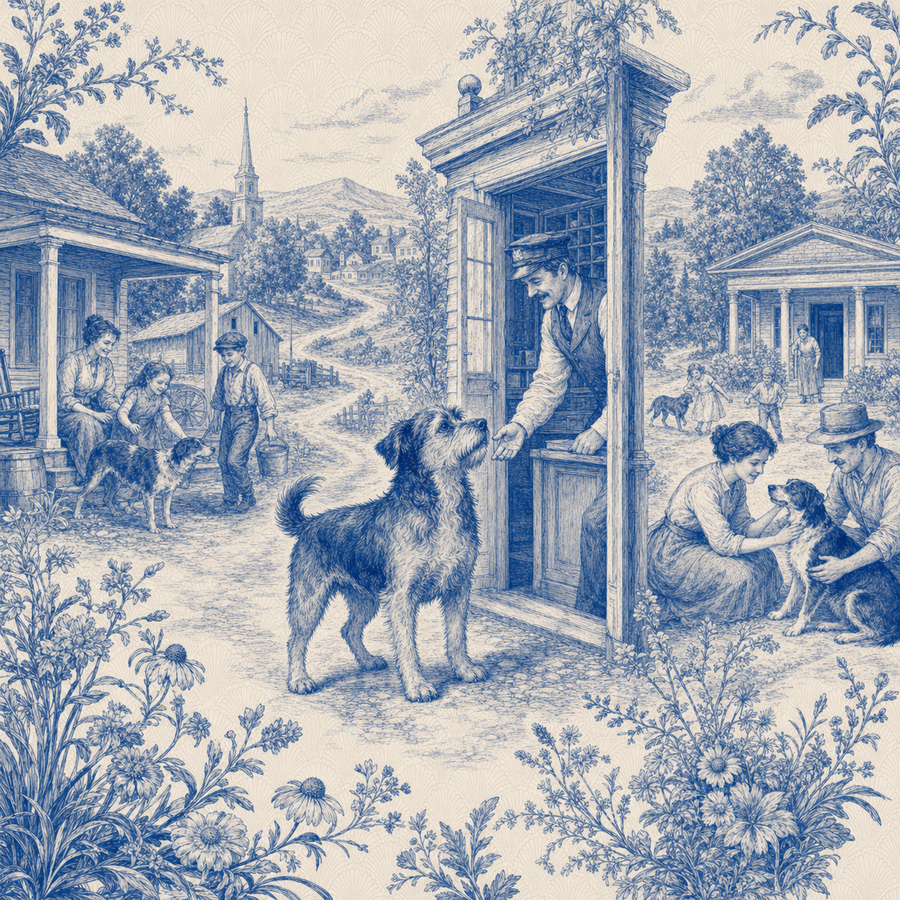
Around 1888, a scruffy stray wandered into the post office in Albany, New York, curled up on a pile of mailbags, and declined to leave. The clerks called him Owney, and when the mailbags rode the trains, Owney rode with them — first across New York, then across the country, and in 1895 around the world. Every stop tagged his collar until he jingled like a charm bracelet of the whole Railway Mail Service. He was nobody’s breed and everybody’s mascot, and he stands in the Smithsonian today. No purebred has ever quite matched him.

The dog the numbers can’t hold
Owney was a mutt, and so, still, is much of America. Near half the dogs in the country are mixed breeds — which makes the All-American, quietly, the most common dog there is, and the only one no kennel club will write a standard for. A mix is an unrepeatable draw from a deep deck: the ears of one ancestor, the run of another, a bark nobody can source. The scores beside this entry are honest middle guesses, and the one set of numbers in this whole guide we will not defend. Your dog is your dog.
What a mix gives up in predictability it often gains in resilience — a wider gene pool tends to spread the risk of the inherited troubles that concentrate in closed lines, though nothing is guaranteed. Living with one is an exercise in paying attention: you learn this animal rather than looking it up. A cheek-swab DNA test can sketch the ancestry, but it changes nothing about the dog asleep on your feet. And there is the part the breed pages can’t offer — a rescued mix arrives already carrying a story, and the rest is the one you write together.
Keeping one happy
Grooming
It depends on the coat you drew — smooth, double, wiry, curly, or some committee decision among them. Match the routine to the coat: short coats want a weekly brush, dense or curly ones far more, and a groomer can tell you what you’re working with. When in doubt, brush more than you think.
Training
Every dog trains on the same currency — patience, consistency, and reward — whatever the mystery in its blood. Watch for the drives that surface as it matures: a herding streak, a nose that quits on a scent, a terrier’s certainty about squirrels. Train the dog in front of you, not the guess about its ancestry, and socialize early.
Exercise
Read the individual, because a mix can land anywhere from couch potato to canine athlete. Start moderate — a good daily walk plus play — and let the dog tell you whether it needs a job and a mountain or a nap and a sunbeam. Adjust as its true energy shows itself over the first year.
Diet
A complete, balanced food matched to size, age, and activity is the whole plan, same as any dog. Keep your dog lean, which is the single most protective thing you can do for any breed or no breed, and let your vet fine-tune portions to the individual in front of you.
America’s actual dog
The mixed-breed dog has no origin story because it has every origin story — it is what happens wherever dogs and people live together without a studbook. In the United States it became a national character: the farm dog, the porch dog, the stray who adopted a post office. The modern shelter and rescue movement gave the All-American a second act, turning the unclaimed dog into the chosen one. It remains, by the numbers, the country’s most common companion.
Questions, answered
Are mixed-breed dogs healthier than purebreds?
Often, somewhat — a wider gene pool tends to dilute the inherited conditions that concentrate in closed lines. It’s a tendency, not a guarantee; individual health still varies and good care still matters most.
Can a DNA test tell me my dog’s breeds?
A cheek swab can sketch the likely ancestry and flag some health markers. It’s genuinely useful and genuinely fun — and it won’t change a thing about the dog you already love.
How do I know how big my rescue puppy will get?
You often don’t, exactly. Paw size, parentage if known, and a vet’s estimate are the best clues; a DNA test can help. Some of it is simply a happy surprise.
Where do I find one?
Local shelters and breed-specific and all-breed rescues are full of them. Petfinder and the Shelter Pet Project aggregate adoptable dogs nationwide.