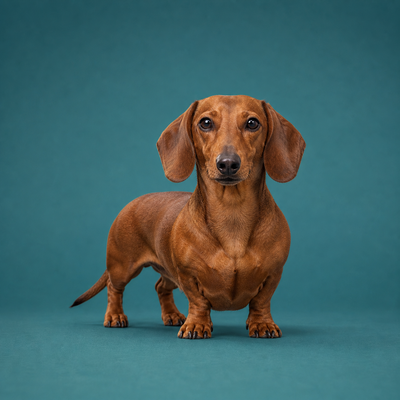
Dachshund
Underneath the punchline, a working hunter.
Andy Warhol did not much like answering questions, so he outsourced the job. Through the 1970s the artist turned up at openings, restaurants, and interviews with Archie, a short-haired dachshund, tucked under his arm — and when a question bored him, he would turn to the dog and let Archie take it. He called Archie his alter ego, and later added a second dachshund, Amos, largely for Archie’s benefit. It was a very dachshund arrangement. No breed has ever doubted its place at the center of the frame with quite this much conviction — and none has better credentials for the confidence.

Bold, at ground level
The confidence has range. In 1972, when Munich needed a face for its Summer Games, the first official Olympic mascot turned out to be a dachshund: Waldi, striped in Olympic colors, drawn by designer Otl Aicher from a real long-haired dachshund named Cherie von Birkenhof. The organizers went further and routed the marathon in the shape of him — thousands of the world’s fittest humans running forty-two kilometers around the outline of a very short dog. Germany knew what it was doing; the country had loved this dog for centuries, and Munich most of all.
Living with a dachshund is a negotiation you will mostly lose, cheerfully. They are brave past the point of good sense — bred to go down a tunnel after something with claws — and the household versions keep the full toolkit: a shockingly large bark, a taste for excavation, and opinions about strangers, delivery schedules, and bedtime. Training works when it seems to be their idea. The one hard rule is the back: keep them lean and off the high furniture, because that long spine is the breed’s known weak point. Everything else is comedy with a loaded spring inside.
Keeping one happy
Grooming
Depends on the coat, and there are three: smooths need little beyond a weekly rubdown; longhairs want brushing a couple of times a week to stop tangles behind the ears; wirehairs add occasional hand-stripping. All three shed moderately. Nails matter more than usual — long nails change how that long body moves.
Training
Stubborn is the breed’s official setting, but it is really independence — a hunter designed to make decisions underground, alone. Short, funny, food-driven sessions win; drills and raised voices lose. Housetraining takes longer than you expect, so start early and stay patient. A well-trained dachshund is a dachshund who agrees with you.
Exercise
Two modest walks a day plus indoor play keeps the engine happy — this is a hound, and hounds like a project for the nose. Sniff walks and scent games beat mileage. Skip the leaping: ramps to the sofa, gates on the stairs, and swimming or strolling over anything jarring.
Diet
Portion control is spinal care: every extra ounce loads the long back, so feed two measured meals and audit the treats, which this breed solicits professionally. Pick a food matched to age and size — minis and standards run different bills. Slow-feeder bowls help the ones who inhale dinner.

Germany’s badger dog goes global
The name is the résumé: Dachshund is German for badger dog, and the breed was engineered — long, low, loud, and fearless — to dig into a sett and argue with what lived there. How long ago is disputed; German foresters were relying on them by the eighteenth and nineteenth centuries at the latest. The AKC recognized the breed in 1885, and the hunter has been a housemate ever since.
Questions, answered
Do Dachshunds bark a lot?
Yes — a big, serious bark and firm opinions about using it. They were bred to be heard from underground; training and company temper it.
Are Dachshunds good with kids?
Good with respectful kids who handle them carefully — rough play and risky lifting are the hazards. Teach children to support that long spine.
What’s the deal with Dachshund back problems?
The breed is prone to intervertebral disc disease. Keeping them lean, limiting jumping, and using ramps dramatically lowers the risk.
What sizes and coats do Dachshunds come in?
Two sizes — standard and miniature — and three coats: smooth, longhaired, and wirehaired. Same conviction throughout.