Bloodhound
Slow to anger, impossible to shake.
In the early 1900s, the most productive detective in Kentucky was a Bloodhound named Nick Carter. Handled by Captain G. V. Mullikin of Lexington, Nick Carter is credited with more than 650 finds, including a trail he successfully ran twelve days after it was laid — cold cases being, to this nose, merely chilled. American courts took the work seriously enough that in some jurisdictions a Bloodhound’s identification remains admissible evidence, which tells you exactly what the law thinks of this dog. What the dog thinks of the law is not recorded. There was, presumably, something to smell.

A nose with seniority
The credentials go back centuries. Medieval Scots called this dog the sleuth hound — the origin, eventually, of every fictional “sleuth” — and told stories of trailing Robert the Bruce and William Wallace by scent alone; true or not, the reputation was already set. Even the name is about pedigree, not gore: a “blooded hound” meant an aristocratic one. The equipment deserves the fame — by some counts around 300 million scent receptors, with those long ears and folded wrinkles working as tools that sweep and trap scent for the nose.
At home, the manhunter is a marshmallow — patient, easygoing, tolerant of children climbing the furniture that is technically the dog. But live with the nose in mind. A Bloodhound who catches a scent resigns from the conversation, entirely and sincerely, so the leash is permanent and the fence is serious. They bay — a sound with real distance on it — and they drool with a craftsman’s consistency: keep towels by the water bowl and lower your standards for the walls. In exchange you get one of dogdom’s gentlest souls, attached to its greatest instrument.
Keeping one happy
Grooming
The short coat needs only a weekly rubdown with a hound glove — the real work is everything else. Wrinkles want regular wiping and drying, and the long ears need weekly cleaning; they hold moisture the way they hold everything else. Baths on a schedule, because that houndy musk is genuine.
Training
Gentle, food-motivated, and monumentally stubborn once the nose votes. Train early, keep sessions short and delicious, and never bother with harshness — a Bloodhound simply waits it out. Recall is theoretical; leash manners are the real curriculum, taught before they reach a hundred pounds. Scent games make training feel like the job they wanted.
Exercise
An hour or more of daily walking — at the dog’s pace, which is the nose’s pace — plus a safely fenced yard. Tracking and trailing sports are the jackpot: an afternoon of scent work buys a sofa-shaped evening. Growing puppies should amble, not jog — save the mileage for grown joints.
Diet
Feed a big, deep-chested hound carefully: two or three smaller measured meals rather than one banquet, calm before and after eating, and know the signs of bloat cold. Watch weight — this frame hides pounds until the joints complain — and expect counter-surfing of professional caliber. That nose knows where everything is.
A thousand years on the trail
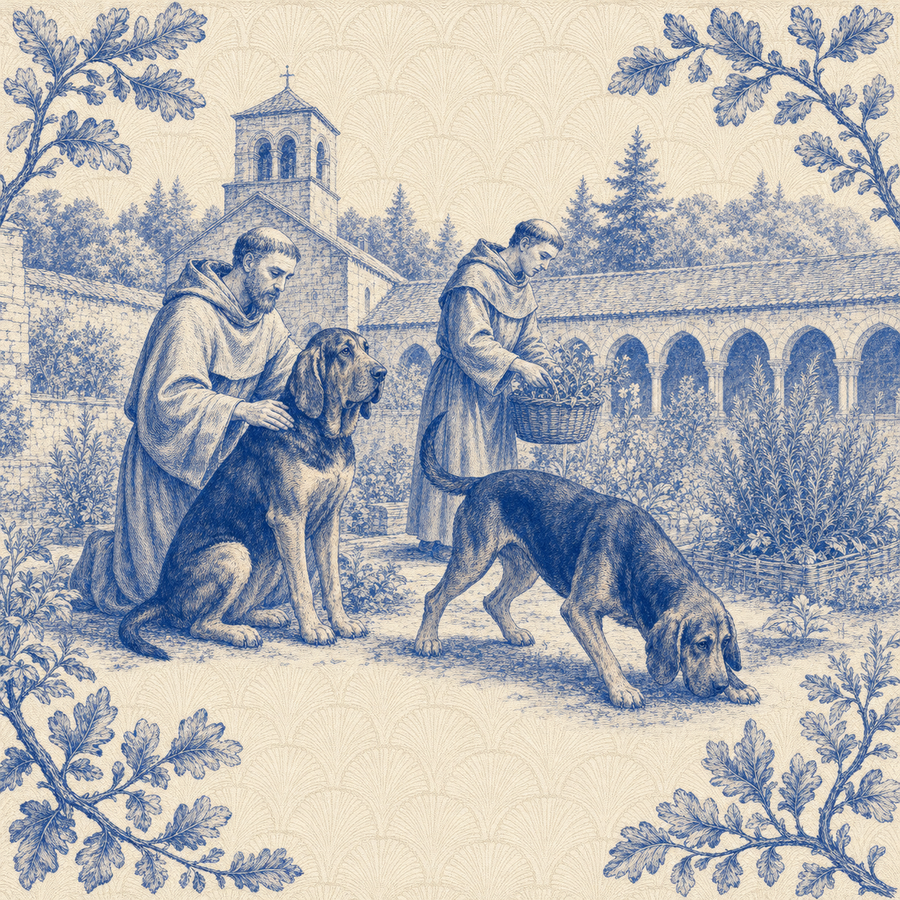
Lore traces the breed to the Abbey of Saint-Hubert in the Ardennes, where monks were breeding renowned black-and-tan hounds around AD 1000; centuries of noble kennels refined the type, and the man-trailing work chose itself. The original European strain faded away, but English breeding preserved the dog we know. The American standard, written in 1896, has scarcely changed since — there was little to improve.
Questions, answered
Are Bloodhounds good family dogs?
Very — gentle, patient, and fond of children. The considerations are practical: size, strength on leash, drool, and a voice the whole street can hear.
Do Bloodhounds drool a lot?
Yes, prodigiously. Bloodhound homes keep towels stationed like fire extinguishers. It is part of the deal, not a phase.
Can a Bloodhound be trusted off leash?
No. A good scent can pull them miles, deaf to everything behind them. Fenced yards and long lines are the arrangement.
How much exercise does a Bloodhound need?
A solid hour or more daily, ideally with sniffing built in. They are moderate-energy but bred for stamina — a bored Bloodhound bays about it.