German Shorthaired Pointer
Runs all day, sleeps on your feet.
In the mid-1800s, German hunters set out to solve a storage problem. A wealthy English sportsman kept a kennel of specialists — a pointer for finding birds, retrievers for fetching them, hounds for fur — but the ordinary German hunter had one dog's worth of space and every job on the list. So they built one dog to do all of it: point, retrieve, trail, swim, guard the house, then come inside and be good company by the fire. Prince Albrecht zu Solms-Braunfels, who steered the project, insisted the dogs be judged on performance, not looks. What they produced may be the most complete hunting dog ever assembled.
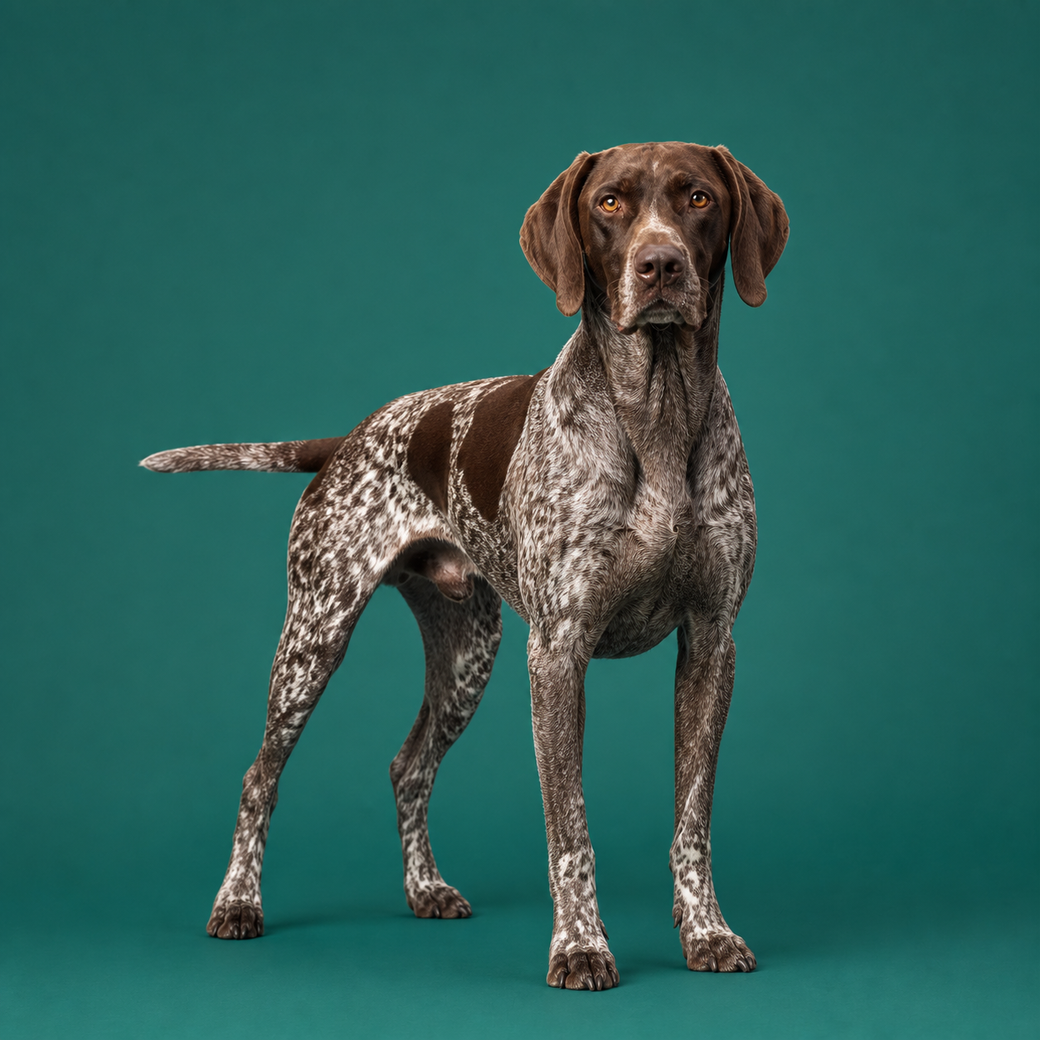
Shorthaired Pointers we love
The whole job description
The versatility now comes with trophies. In February 2016, a three-year-old named California Journey — CJ to everyone — took Best in Show at Westminster, the breed's third such win; his grandmother Carlee had done it in 2005, which makes it something like a family business. America has noticed the whole package: the GSP currently sits ninth in the AKC's popularity rankings, remarkable for a serious hunting dog. The liver-and-ticked coat still turns up in duck blinds and pheasant fields every fall, doing exactly what the 1800s ordered.
Living with one is a two-part contract, and both parts are enforced. Part one: real exercise, every day, in weather. A GSP's engine does not idle — under-run, they will rehearse their profession on your furniture, your garden, and the neighborhood squirrels. Part two: proximity. This breed was designed to work beside one hunter all day and never really got over it; they lean, follow, and sleep pressed against you like a sixty-pound heated blanket. Meet the contract and you get one of the most cheerful, capable companions in dogs.
Keeping one happy
Grooming
The slick coat looks like zero work and is nearly that: a weekly once-over with a rubber grooming mitt, baths when earned. Fair warning — those short, stiff hairs shed more than people expect and weave into upholstery like tailoring. Dry the ears after every swim, which will be often.
Training
Bright, biddable, and eager enough that training mostly means steering. Start young, keep it positive, and proof the recall long before the first bird season — a nose this good outranks a shout. Give the instincts legal work: fetch, scent games, field training. An employed GSP is an easy student.
Exercise
Plan on an hour or two of genuine, heart-rate exercise daily — running, swimming, hard fetch, fieldwork — plus mental employment. A walk around the block is a warm-up, not a workout. The adolescence runs long, roughly to age three. Tired is not a problem you will ever create by accident.
Diet
Feed a quality food in measured meals, scaled to the week's actual mileage — these athletes burn hot in season and gain in the off-season. As a deep-chested breed they carry real bloat risk: calm mealtimes, no hard running right after eating, and learn the emergency signs early.
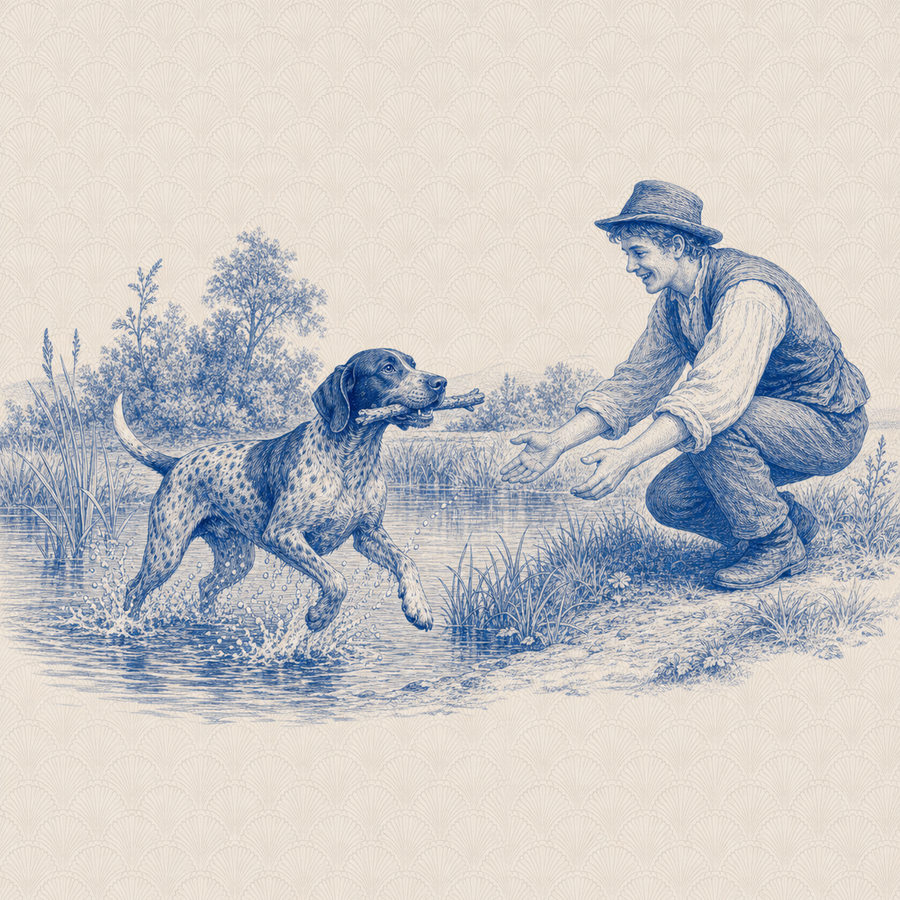
One dog for every job
Nineteenth-century German breeders crossed old Spanish and German pointers with scent hounds, then added English Pointer speed in the 1860s, all in pursuit of a single versatile hunter — fur and feather, land and water. Dr. Charles Thornton of Montana whelped America's first documented litter on July 4, 1925, and the AKC admitted the breed to its stud book in 1930.
Questions, answered
Do German Shorthaired Pointers shed?
Yes — surprisingly much for a short coat, year-round. The hairs are small and stubborn rather than dramatic. Not hypoallergenic.
Can a GSP live in an apartment?
Only with an athlete's exercise schedule attached. This is a high-drive hunting breed; the housing matters less than the mileage.
Are GSPs good family dogs?
Excellent with active families — affectionate, playful, and patient. Their bounce can flatten toddlers, so supervise the small ones.
How much exercise does a GSP need?
An hour or two of hard exercise daily, plus mental work. Under-exercised GSPs invent hobbies nobody enjoys.