Shih Tzu
The palace job outlived the palace.
Count the ancestors of every Shih Tzu on earth and you arrive at fourteen dogs. When China’s imperial world collapsed, its pampered lion dogs collapsed with it — after the 1949 revolution the breed was effectively wiped out in its homeland as a symbol of wealth — and the entire line came down to thirteen dogs carried to England and Scandinavia between 1928 and 1952, plus one black-and-white Pekingese folded into the recipe: a scandal at the time, salvation in hindsight. Fourteen animals, and from them, one of the most beloved toy dogs in the world. Dogdom has no closer brush with vanishing.

Charm as a profession
Before the bottleneck, there was the palace. The Empress Dowager Cixi — who received lion dogs as tribute from the Dalai Lama — kept a breeding program devoted to them, and generations of Chinese court life shaped an animal optimized for exactly one thing: being adored at close range. The name translates as “lion dog,” which is court flattery of a high order; the standard describes a proud, arrogant carriage, and the breed agrees. This is not a hunter, a herder, or a guard that shrank. The Shih Tzu was never anything but a companion, and it is a master of the craft.
The mastery shows daily. Shih Tzus are sturdy, merry, and genuinely convinced that laps are load-bearing architecture; they meet children warmly, tolerate apartments happily, and require exercise in amounts a hallway can supply. The honest ledger: housetraining tests patience, the magnificent coat is a standing appointment or a standing haircut, and the pushed-in face means heat is a genuine hazard — summer is for air conditioning, not jogging. Stubbornness is real but negotiable with snacks. What they ask is presence. Centuries of selection built a dog that finds your company the entire point.
Keeping one happy
Grooming
Kept long, the coat needs daily brushing and regular baths; most pet homes choose the sensible “puppy cut” and a groomer every four to six weeks instead. Either way, clean the face daily — those big eyes collect trouble — and keep the topknot or trim out of them. Check ears weekly.
Training
Sweet, social, and quietly immovable: Shih Tzus respond to cheerful, food-heavy sessions and ignore anything resembling a drill sergeant. Housetraining is the long campaign — stay consistent, celebrate every success, and consider it a months-long project. Start grooming handling in puppyhood so the lifelong salon habit feels normal.
Exercise
Modest by design: short daily walks and living-room play cover the requirement, which makes them among the easiest city dogs going. Mind the flat face — no exertion in heat or humidity, ever, and carry water in summer. Their favorite sport remains supervising the sofa from within arm’s reach.
Diet
Small, measured meals — this is a little dog with a talent for acquiring snacks, and extra weight burdens the back and the breathing. Two feedings a day suit most adults. Watch for guarding of food around other pets, and keep human-table charity to a minimum; the eyes are professionally persuasive.
Tibet to Peking to everywhere
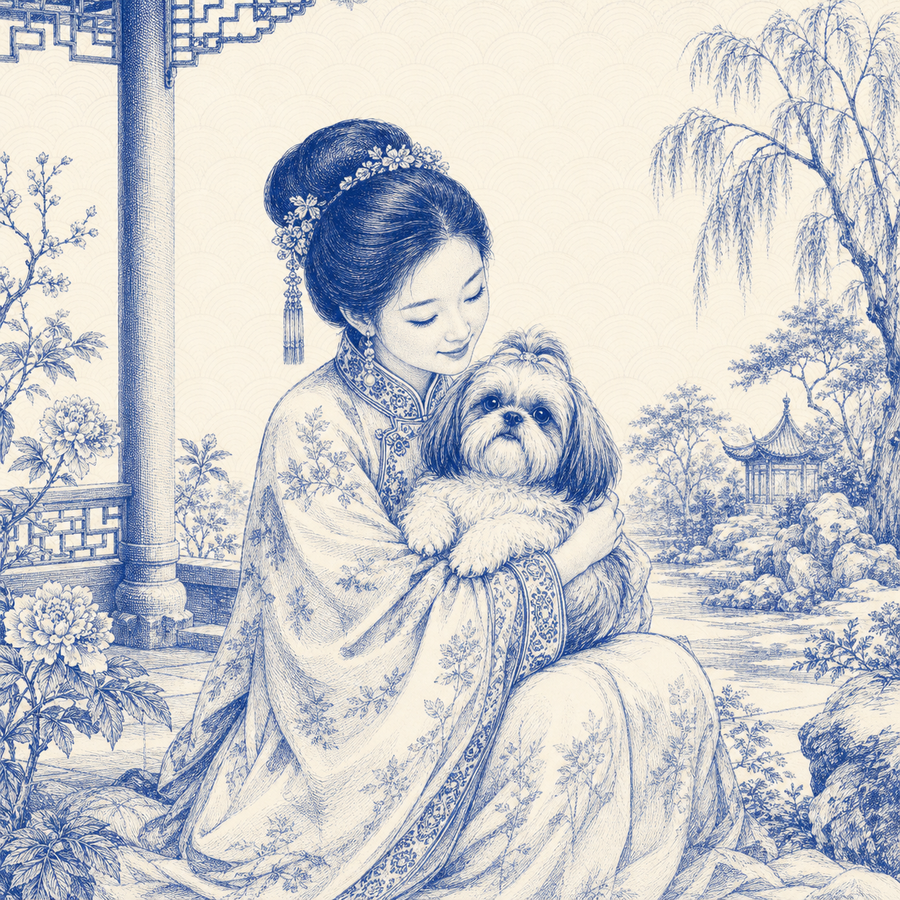
The breed descends from Tibetan lion dogs sent to the Chinese court, where centuries of imperial favor perfected a companion in miniature. Englishwoman Lady Brownrigg brought the first dogs to Britain in the 1930s, American servicemen carried them home after the war, and the AKC opened its studbook to the breed in 1969. The lap has been occupied ever since.
Questions, answered
Do Shih Tzus shed?
Very little — the long coat holds its hair, which is why it mats instead. The work is brushing and trims, not vacuuming.
Are Shih Tzus hypoallergenic?
One of the better choices for allergy-sensitive homes, though no dog is truly 100% hypoallergenic. Spend time with one before deciding.
Are Shih Tzus hard to potty train?
Famously slow — plan on months of consistent scheduling, rewards, and patience. They get there; they simply decline to rush.
Are Shih Tzus good with kids?
Yes — sturdy, playful, and tolerant, they are among the most kid-compatible toy breeds. Teach gentle handling and supervise the smallest.