Siberian Husky
The wrong dog got the statue.
There is a statue of a sled dog in New York’s Central Park, and the name on it is Balto — the team leader who ran the final fifty-three miles of the 1925 relay that carried diphtheria serum through a blizzard to icebound Nome, Alaska. Ask a husky person about it, and watch their face. The longest, deadliest stretch of that run — 264 miles, including a night crossing of the cracking ice of Norton Sound — belonged to Leonhard Seppala and his twelve-year-old lead dog, Togo, who waited another seventy-six years for a statue of his own. Two heroes, one spotlight. The breed never seemed to mind.

Endurance, with a sense of humor
The Siberian Husky was engineered by some of the toughest dog breeders who ever lived: the Chukchi people of northeastern Siberia, who over countless generations built a sled dog that could haul light loads over absurd distances on almost no food — and then come into the tent and be gentle with the children. Both halves survived the voyage to America, where the little Siberian imports embarrassed the local freight dogs in the great Alaskan races. Neither the friendliness nor the mileage is an accident. Both are the design.
Living with one is a negotiation with all of it. Huskies need real running — miles, most days — and a fence with credentials, because this breed treats a closed gate as a puzzle with a personal best attached. They rarely bark; they howl, mutter, and deliver speeches. They shed on a schedule of their own devising. And they are constitutionally friendly — burglars included — which makes them poor guards and marvelous company. A tired husky is a sweet, comic roommate. An under-run husky is the reason the sofa is gone.
Keeping one happy
Grooming
That dense double coat mostly runs itself — huskies are famously clean and rarely need baths. The bill arrives twice a year, when the undercoat blows out in grocery-bag quantities: brush daily through the blow, weekly the rest of the year. Never shave a husky — the coat insulates against heat as well as cold.
Training
Bright, cooperative in spirit, and independent in practice — a husky understands the request fine and weighs it on the merits. Keep sessions short, rewarding, and varied, and make peace with the leash early: recall is never trustworthy in a dog bred to run over the horizon. Mushers learned this centuries ago. Believe them.
Exercise
Serious and non-negotiable: an hour or two a day of running, hiking, bikejoring, or pulling — this is an athlete built to work all morning and ask what’s next. In warm weather go early and gently; that coat is Arctic equipment. A bored husky digs, chews, and plans escapes.
Diet
An efficient engine: bred to work far on remarkably little, many huskies eat lightly for their size and some are downright picky. Feed measured meals matched to actual workload, and check condition by hand through the seasons — under all that coat, both ribs and extra pounds hide with equal skill.
Out of Siberia, at full stride
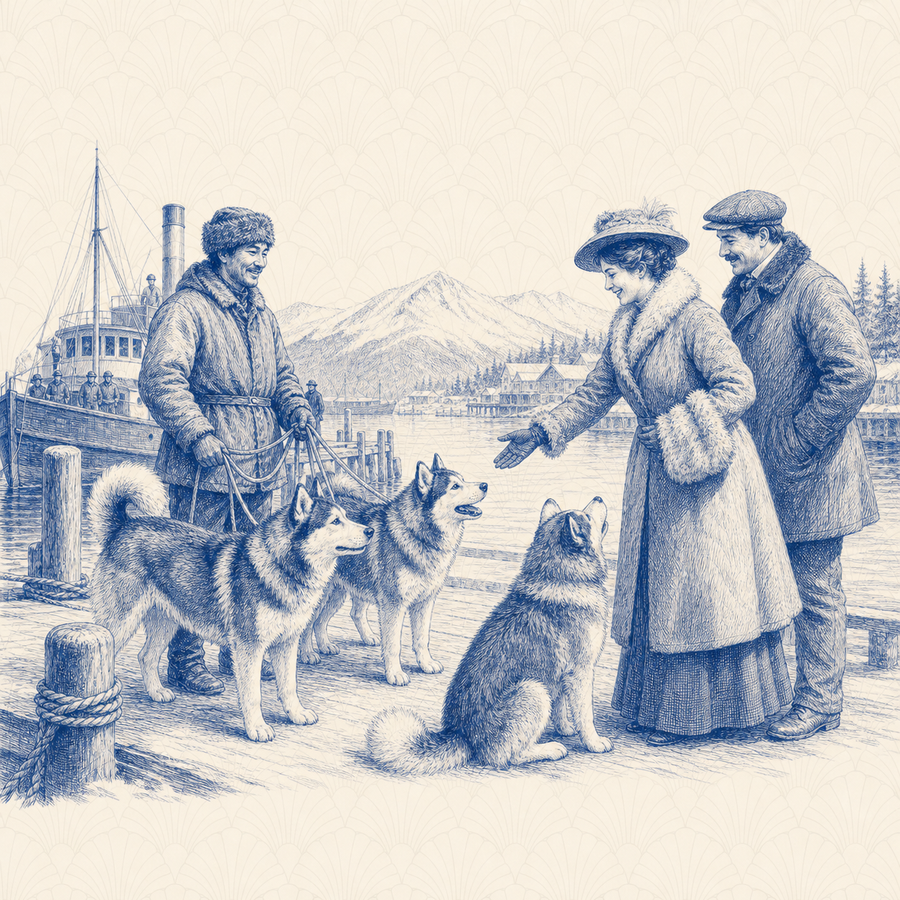
The breed’s deep history belongs to the Siberian Arctic; its modern chapter opened in 1908, when traders began shipping sled teams to gold-rush Alaska, where the small, tireless newcomers rewrote the racing record book — and, in time, the definition of a family dog. The AKC recognized the breed in 1930, the same year exports from Siberia ended. Every Siberian Husky since descends from those emigrants.
Questions, answered
Do Siberian Huskies shed a lot?
Tremendously — steady shedding plus two full coat blows a year. Not remotely hypoallergenic.
Can a husky live in an apartment?
Only alongside a serious daily running habit. It’s the mileage that matters, not the square footage.
Do huskies bark a lot?
Rarely — they howl, “talk,” and deliver monologues instead. Quieter than a watchdog, more musical than the neighbors expect.
Are huskies good with kids?
Famously friendly and gentle with people, kids included — supervise mainly for exuberance, not temper.