Toy Fox Terrier
Left the circus, kept the act.
The Smooth Fox Terrier arrived in America as a gentleman’s hunting companion and promptly took a farm job, clearing rats from barns across the rural United States. Farm families noticed something the show world had missed: the smallest ones — the seven-pound runts no breeder bragged about — were often the quickest, scrappiest, funniest workers in the litter. So Americans bred for the runt, on purpose, for decades. The little dogs that resulted ratted by day and performed by instinct, and circus clowns took them on as sidekicks — a Toy Fox Terrier can learn a trick roughly as fast as a clown can invent one.
A terrier, concentrated
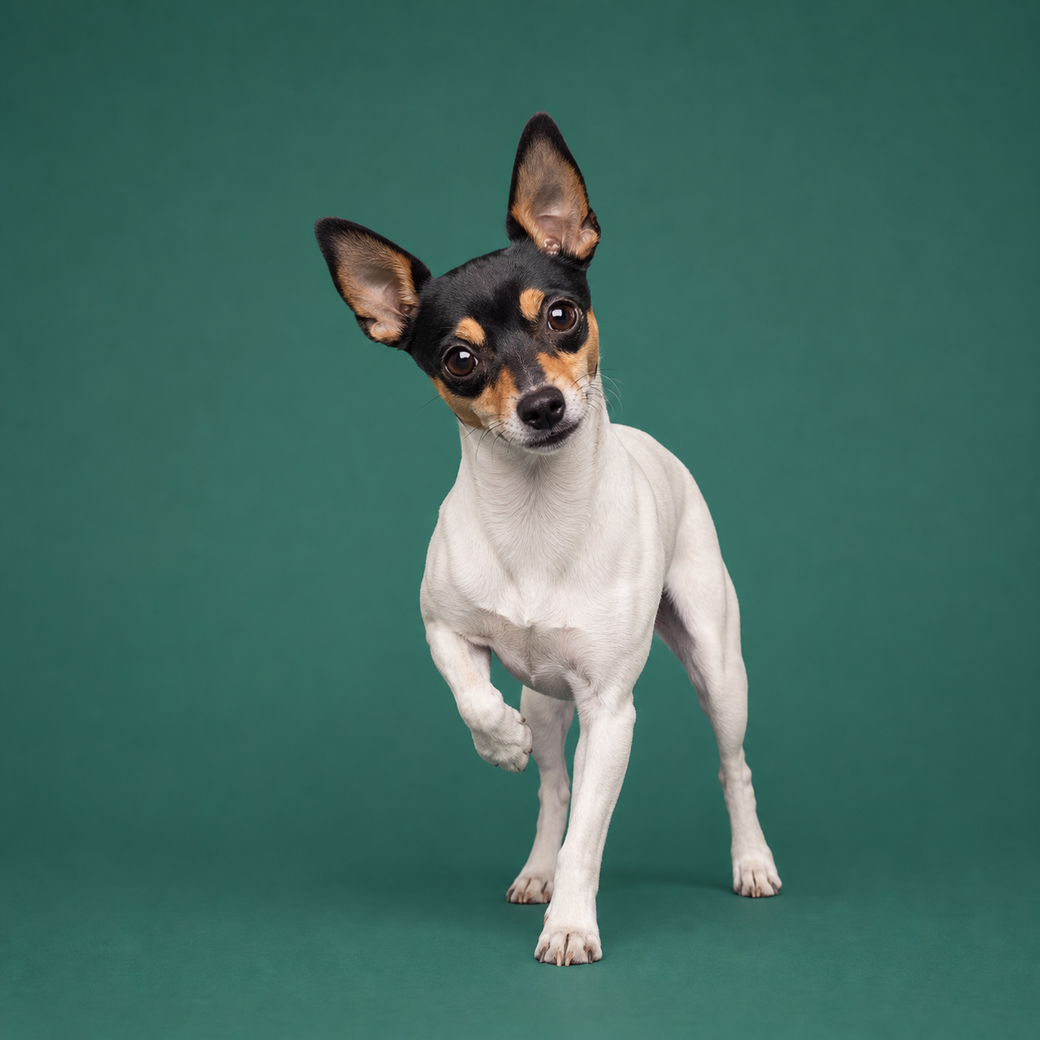
What the breeders got was not a scaled-down hunting dog but a new personality entirely — which is why old-timers gave it a name of its own, the AmerToy. The toy half brought a lapdog’s genuine devotion and an uncanny read on their person’s moods; the terrier half kept every volt of the original wiring. Owners describe the result as a big dog in a little body, and the dog plainly agrees — challenging the vacuum cleaner, commanding the sofa, and assigning themselves patrol duties nobody posted. The breed has even been trained for hearing-assistance work: all that attentiveness, given a job.
They are, mercifully, a manageable amount of all that. The coat is wash-and-wear; the size fits any apartment; the athleticism fits in a hallway when it must. They train remarkably fast and bond hard, expecting to be in the room and preferably on the person. The honest bill: real watchdog barking without training, a prey drive out of all proportion to the body, loud objections to cold weather, and a fine-boned frame that does better with gentle older kids than with toddlers. Budget for a sweater. They will wear it with dignity.
Keeping one happy
Grooming
As easy as grooming gets: a short satin coat, a quick weekly brush, an occasional bath. Shedding is modest but steady. Spend the saved minutes on teeth — small mouths crowd, and dental care is this breed’s long game — and on nails, which outgrow their tiny workload.
Training
A standout student — quick, attentive, and eager, with little of the classic terrier stonewalling; this is one of the most trainable of all the toys. Keep sessions short and playful, fold tricks into the manners curriculum, and housetrain with patience and a schedule: small bladders make big promises they cannot keep.
Exercise
Real terrier energy in an economy package: a couple of brisk walks plus honest indoor play largely covers it, because a living room is a racetrack at this scale. Mind the prey drive outdoors — leash or fence, always — and mind the thermometer; a shorthaired six-pounder has no patience for January.
Diet
Small dog, fast metabolism: two or three small measured meals beat one big one, and toy puppies need real watchfulness against low blood sugar. Calories hide in training treats — budget them against the trick habit. Keep them lean; those little kneecaps do better on a light chassis.

An American original, in miniature
The little dogs took shape on early-twentieth-century American farms, bred down litter by litter from full-sized ratting terriers. The United Kennel Club registered them in 1936 and has championed the breed since; the AKC said no in 1915, kept saying no for decades, and finally said yes in 2003, filing the breed in the Toy Group. It remains one of the few breeds invented entirely in America.
Questions, answered
Are Toy Fox Terriers good apartment dogs?
One of the best-suited terriers for it — small, clean, and able to burn energy indoors. Manage the barking and they make first-rate city dogs.
Do Toy Fox Terriers bark a lot?
They’re alert and opinionated — expect watchdog announcements. Training and enough activity keep it to headlines rather than full coverage.
Are Toy Fox Terriers good with kids?
Better with gentle older kids — the attitude is sturdy, but the single-digit-pound body is not.
Do Toy Fox Terriers shed?
Moderately — the short coat drops fine hairs year-round, but grooming takes minutes. Not hypoallergenic.