Vizsla
A thousand years old, and still underfoot.
In 1950, a Vizsla named Sari was carried out of Soviet-occupied Hungary by refugees and smuggled into Rome. Word of her reached Emmett Scanlon, an American State Department employee, and by the end of the year Sari and her two pups were bound for Kansas City — founding stock for an entire American breed. It was a near thing. The golden-rust pointer of the Hungarian nobility had barely survived the war, and its rescue ran on a single stubborn fact: people who fled with nothing kept finding room for the dog. Vizsla owners will recognize the arrangement.
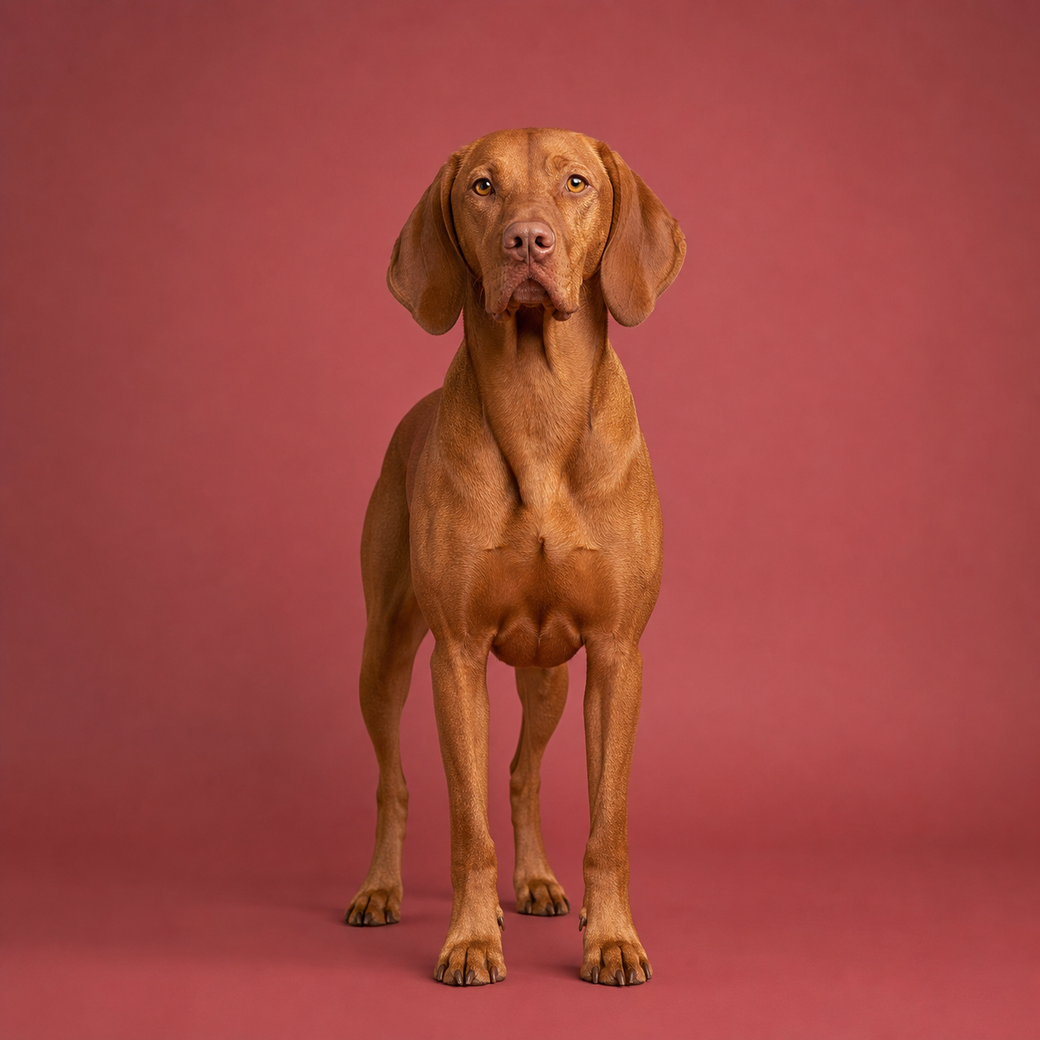
Bred for constant contact
The pedigree may be a thousand years deep. The Magyars who settled the Carpathian Basin bred the Vizsla’s ancestors to hunt alongside falcons — a primitive stone etching survives showing hunter, falcon, and an unmistakably Vizsla-shaped dog working as a team — and Hungarian nobles spent the following centuries refining a swift, russet-gold pointer that worked close and slept closer. The closeness is the inheritance that matters. This is a breed that holds contact with its person like it is part of the job description: a hunting partner in the field, an assistant everywhere else.
Living with one means sharing a schedule. A Vizsla needs an hour or two of hard exercise a day — running, field work, fetch past the point of your own good sense — and files their complaints about any shortfall in moans, whines, and full theatrical sighs. They are genuinely miserable alone; this is a dog for households that are mostly home. Kept busy and kept company, they are among the finest companions in dogs: gentle, biddable, clean, nearly odorless, and attached to you with a completeness that surprises even people who thought they wanted a devoted dog.
Keeping one happy
Grooming
The short russet coat asks almost nothing: a weekly polish with a soft brush and a bath when they find something worth rolling in. With no undercoat, shedding stays modest — and winter genuinely bites, so a coat is a kindness, not a costume. Trim nails monthly and dry the ears after swims.
Training
Eager, quick, and soft-hearted: a Vizsla learns fast and wilts under harsh handling, so keep training positive, consistent, and generous. Start early, socialize widely, and give the hunting brain real work — retrieving, scent games, field training if you can get it. A well-taught Vizsla is nearly telepathic; an untaught one is a very fit toddler.
Exercise
Plan on an hour or two of genuine daily work: running, biking, swimming, field time — a leashed stroll is a rounding error to this breed. They make superb running partners once fully grown. Shortchange the exercise and the energy reroutes into the house; pay it, and they settle beautifully.
Diet
An athlete’s appetite in a lean frame: feed measured meals twice a day, matched to the workload, and keep them trim — you should see the last rib in motion. Skip strenuous exercise right around mealtimes, and count training treats against the total. Most Vizslas are enthusiastic, uncomplicated eaters.

A millennium, twice nearly lost
Magyar horsemen bred the Vizsla’s ancestors in the Carpathian Basin a thousand years ago, and Hungary’s nobility kept the golden pointer close for centuries — so close the breed nearly died with them, first in the World Wars, then under the Soviet regime that followed. Rebuilt from the handful of dogs that reached the West, the breed arrived in America in 1950; the AKC recognized it in 1960, as its 115th breed.
Questions, answered
Why do Vizslas follow you everywhere?
Centuries of breeding for close work — the breed was designed to hunt in constant contact with its person, and the instinct transfers directly to kitchens and bathrooms.
Can a Vizsla be left alone all day?
No — this is one of the most people-dependent breeds there is. Long, regular alone-hours make for an anxious, vocal, destructive dog.
Do Vizslas shed?
Moderately — the short coat drops fine rust-colored hairs year-round, but there is no undercoat and no seasonal blowouts. Not hypoallergenic.
Are Vizslas good family dogs?
Excellent with active families — gentle, playful, and devoted. They are bouncy, though, and toddlers can get knocked over by sheer affection.