West Highland White Terrier
The white coat was a safety feature.
The story is told of Poltalloch, on Scotland’s west coast, sometime in the 1800s: Colonel Edward Malcolm, out shooting, saw a flash of reddish fur break from cover and fired — then discovered he had killed his own terrier, mistaken for a fox. As the legend goes, Malcolm resolved that day to breed only white dogs, dogs no gun could ever confuse with quarry. However much the tale has been polished by a century of retelling, the dog it explains is real: a small, hard, cheerful Highland hunter in a coat of unmissable, unmistakable white.
Confidence, in white
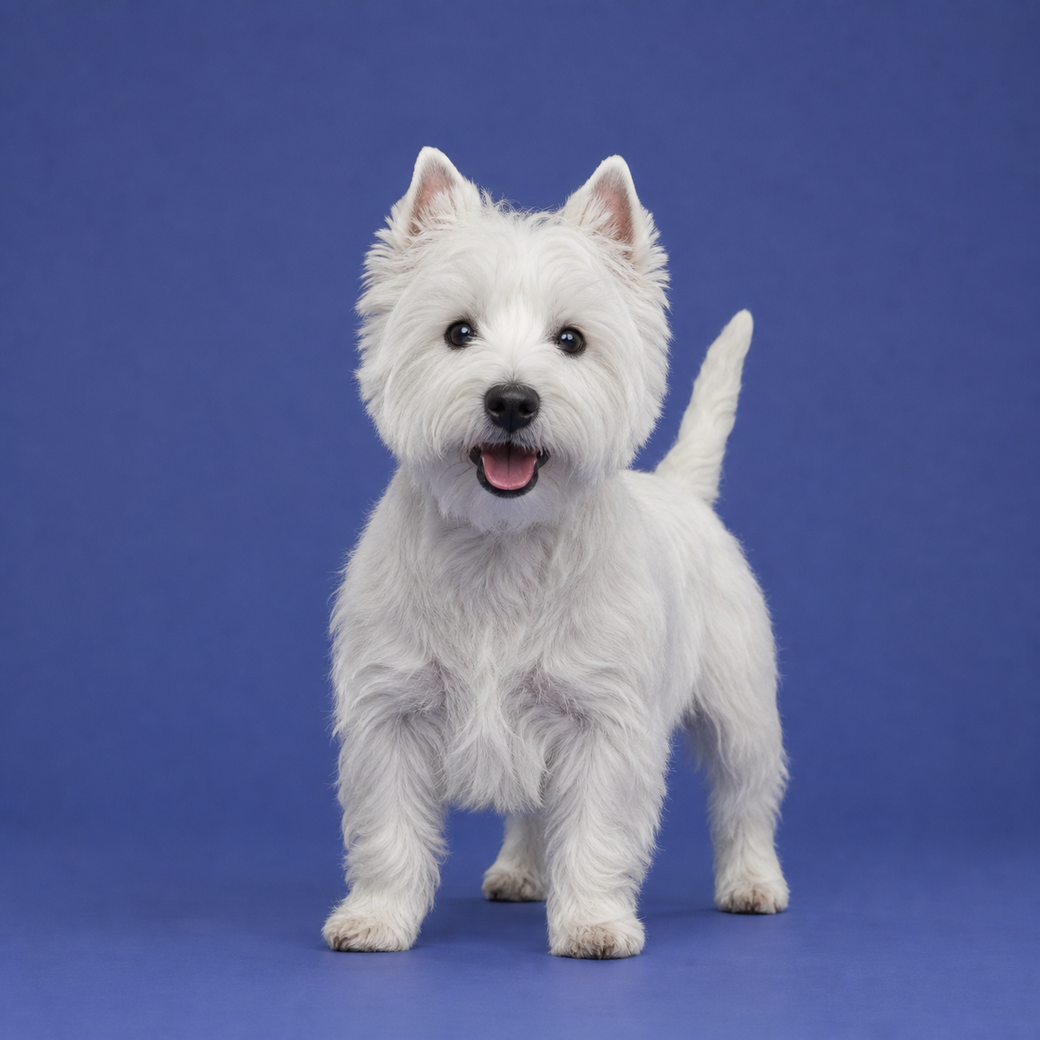
Few breeds have done more commercial modeling. When the whisky baron James Buchanan wanted mascots for his Black & White blend, he chose — after a visit to a dog show — a black Scottie and a white Westie, and from the 1920s the pair sold Scotch around the world, eventually landing on the bottle’s label itself. Decades on, the breed became the face on the Cesar pet-food tray. The appeal is no mystery: an all-white terrier with button eyes and a carrot tail reads instantly at any size. Advertising found the breed irresistible. Advertising has a point.
At home, the Westie is self-assurance on short legs. They are sturdier and more sociable than most terriers — game for children who play fair, adaptable to city flats and farmyards alike — and they meet the world with a busy, self-employed cheerfulness. The original job persists: they dig, they chase, they editorialize at the door, and their recall dissolves in the presence of squirrels. Skin allergies run in the breed and are worth asking any breeder about. What you get for the trouble is a large personality at convenient scale, entirely convinced of its welcome.
Keeping one happy
Grooming
The hard white coat sheds lightly but wants regular work: brush a few times a week, and plan on hand-stripping every few months to keep the harsh, weatherproof texture — or choose a clipped pet trim, easier and softer. White shows dirt honestly; happily, most of it brushes out once dry.
Training
Bright, willing, and independent in roughly equal parts: keep sessions short, upbeat, and worth their while, because a bored Westie simply resigns. Housetraining and recall take patience — earthdog instincts do not negotiate. Socialize early, and teach a quiet cue before the doorbell teaches its own curriculum.
Exercise
A brisk walk or two a day plus real play covers the body — this is a moderate-energy terrier, not a sled dog. What they crave is occupation: sniffing expeditions, games with rules, digging pits with planning permission. A patrolled garden is bliss; an unsupervised flowerbed is a dig site.
Diet
Two measured meals a day keep a Westie trim under all that coat — small, sturdy dogs gain quietly, and the breed’s skin does best on a consistent, high-quality diet. If itching flares, food trials are worth discussing with your vet. Count the treats; those eyes are professionals.
From the cairns, in white
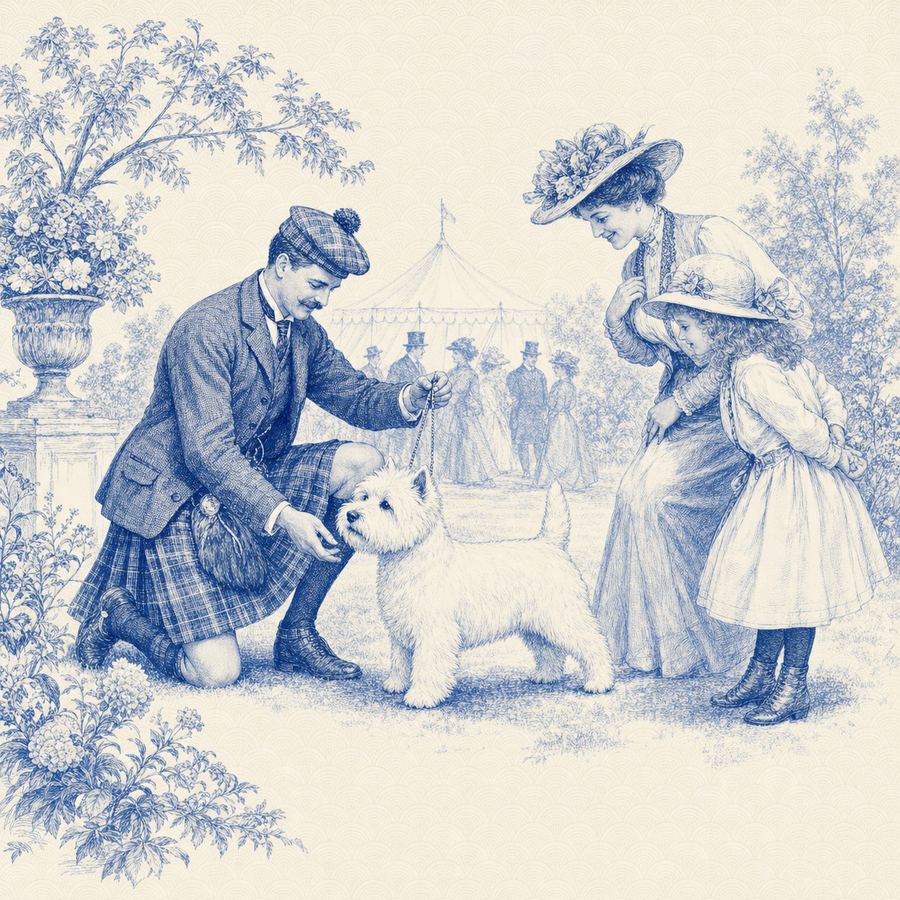
The Westie belongs to Scotland’s old family of short-legged earth terriers, bred to bolt fox, badger, and rat from the rocks — kin to the Cairn and the Scottie, sorted for generations largely by color. The white strain fixed in Argyll took the name West Highland White Terrier at Crufts in 1907; the AKC recognized the breed in 1908, and the American parent club formed the year after.
Questions, answered
Are Westies hypoallergenic?
A popular pick for allergy-sensitive homes — the hard coat sheds little — but no dog is truly 100% hypoallergenic. Spend time with one first.
Do Westies bark a lot?
They are alert little watchdogs and will announce events. Training and enough occupation keep it to bulletins rather than broadcasts.
Are Westies good with kids?
Among the best terrier matches for families — sturdy, playful, and patient with children who handle them respectfully.
How much grooming does a Westie need?
Brushing a few times a week, plus hand-stripping or clipping every couple of months. The white stays whiter than you would expect.